Seven perspectives on pathways, rural gaps, and the power of collaboration.
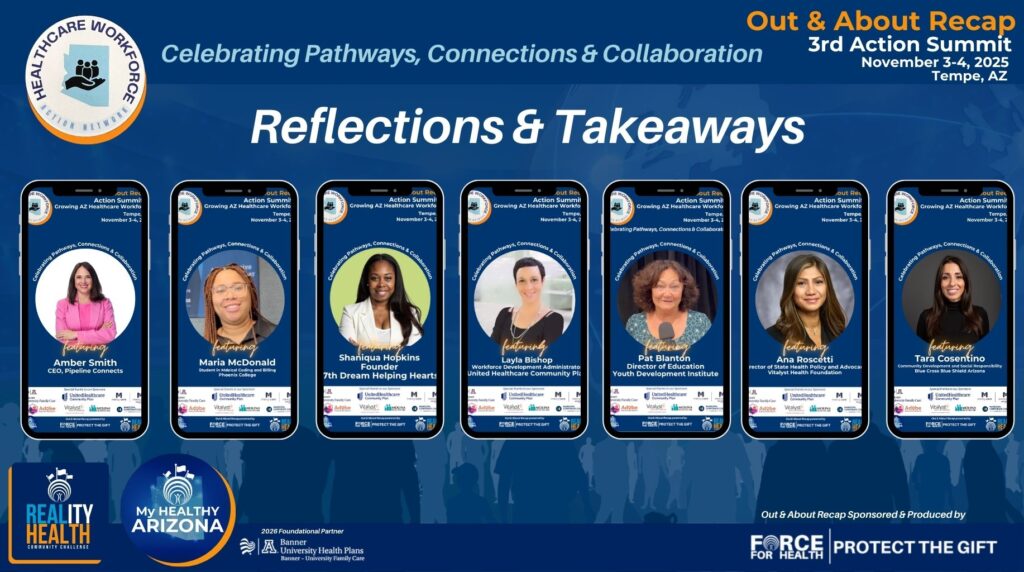
On November 3-4, 2025, The Force for Health® Network was proud to partner with the Arizona Healthcare Action Network for their 3rd Annual Action Summit, to address the critical gap in the healthcare workforce space here in Arizona and to do something about it, by interviewing some key participants for their feedback and takeaways below. You can read more about the Summit in a separate post recapping the event here in a post called Out & About: Growing Arizona’s Healthcare Workforce – Pathways, Connections & Collaboration.
Across these interviews, one theme kept surfacing: Arizona’s healthcare workforce challenge isn’t a single-organization problem — it’s a shared community opportunity. From statewide career pipeline data to student pathways, rural access barriers, and the human side of leadership, each speaker reinforced that solving this crisis requires aligned action across education, employers, health systems, and policymakers.
1) Amber Smith (Pipeline Connects) — Turning a workforce “crisis” into a pathway opportunity
Amber Smith framed the issue with data and urgency: too few students complete post-secondary training, and even fewer align that training with in-demand careers. She emphasized that healthcare remains a top interest area for K–12 students — but interest isn’t translating into a clear, supported pipeline. She highlighted Pipeline Connects as infrastructure for that connection, describing strong statewide usage and employer demand, and closed with a clear message: collaboration and data-driven investment are the unlock.
“The key to solving our healthcare crisis is the same solution for all things: collaboration.”
2) Shaniqua Hopkins (7th Dream Helping Hearts) — Building an on-ramp into healthcare through billing & coding
Qua Hopkins came as both a healthcare professional and a builder of access. She described creating a medical billing program to help people get their “first step” into healthcare — especially for those who don’t have networks or insider access. She underscored rural disadvantages, shortages, and the reality that many people can’t break in without experience. Her program is positioned as a practical entry point: 10 weeks, hybrid, lower cost, and designed to open doors into broader career mobility.
“I want teens to know you just have to start somewhere, and we’re giving you the opportunity right here.”
3) Pat Blanton (Youth Development Institute) — A call for “all business” collaboration
Pat Blanton attended to learn and left impressed by how many people are actively working on Arizona’s healthcare needs. Speaking from a youth residential treatment context, he broadened the frame: healthcare workforce development impacts medical, behavioral, emotional, and social needs — and the responsibility to solve it can’t sit only with healthcare organizations. His message was direct: leaders across sectors should engage.
“This is gonna take more than just the healthcare folks — it’s gonna take all the business collaborating together.”
4) Layla Bishop (UnitedHealthcare Community Plan) — From updates to real implementation
Layla Bishop spoke as both a planning-committee member and a community advocate. She praised the summit content and the value of competitors coming together with “one voice.” What stood out to her most was the authenticity of panels and the power of hearing from students — including billing/coding, second-career learners moving toward nursing, and others entering the field with momentum. She celebrated that this is truly an Action Network — not just talk, but follow-through. She also offered a deeply human message about representation: being seen, being heard, and having voices at the table who can drive change.
“We see you, we hear you… and there are enough of us who are at the table sharing your voice and listening to your voice to make a real change.”
5) Anna Rosetti (Vitalyst Health Foundation) — Rural workforce requires a different strategy
Anna Rosetti brought a policy and systems lens, grounded in the reality that rural recruiting and retention are not simply “urban strategies, scaled out.” She highlighted the value of rural hospitals collaborating—pooling resources and funding solutions together, even down to sharing specialists. She also pointed to ongoing barriers like internships and apprenticeships, and stressed the need to identify practical solutions so students can train, enter the field, and practice with confidence.
“Workforce and recruiting and retaining workforce talents in rural Arizona is so much different than in urban areas.”
6) Maria McDonald (Phoenix College student) — Leadership felt human, so he found his voice
Maria McDonald shared what it meant to attend his first summit and step into a student panel role. He described the energy of meeting leaders across specialties and learning how people communicate, think, and act — especially noticing that even “high official” leaders sometimes pause, reflect, and don’t pretend to have perfect answers. That observation helped him overcome pressure and fear. His takeaway was practical and empowering: ask questions, show up, take opportunities even when nervous. He also spoke about his future path toward health informatics and how networking is helping him shape direction.
“Ask questions — even if you feel uncomfortable.”
7) Tara Cosentino (Blue Cross Blue Shield of Arizona) — Radical collaboration and the power of “we”
Tara Cosentino emphasized relationship-building across Arizona’s workforce ecosystem, with special love for rural communities. She lifted up the concept of radical collaboration — rethinking partnership across sectors and resisting siloed approaches. Her message focused on collective impact: the “we” is bigger than any single organization. She also encouraged families to connect with schools and advocate for access to career readiness and career development resources so students can explore the full diversity of healthcare careers.
“The ‘we’ is collective in this state — and not just our siloed organizations.”
Closing takeaway
Together, these seven voices paint a clear picture: Arizona’s healthcare workforce challenge is real — but so is the opportunity. The throughline is connection: connecting students to pathways, rural communities to resources, employers to talent, and systems to each other through collaboration that’s sustained and measurable.
The U.S. has a violent child death problem. Developing strategies to prevent violent child deaths death from firearms and traffic crashes is a demanding task that requires consideration of numerous upstream, interrelated, and tangential issues. To help safety advocates develop strategies to prevent violent child death, we compiled five frameworks to help: Understand and explain …
The post 5 Essential Frameworks for Preventing Violent Child Death appeared first on Salud America.
The US is experiencing a maternity healthcare crisis where pre-term labors and infant and maternal mortality rates are up due to a lack of access to prenatal and postpartum care. Many of these women live in areas designated as maternity care deserts. These are areas where pregnant individuals and mothers have limited or nonexistent access …
The post Report: Over a Third of US Counties Are Maternity Care Deserts appeared first on Salud America.
Some big changes in 2022 and 2023 have set up the healthcare sector to advance screening for non-medical social needs in 2024 and beyond. This is great news as we work to address social determinants of health (SDoH), improve health outcomes, and reduce health disparities. But one key social need – transportation – isn’t getting …
The post As Social Need Screening Advances, Transportation Remains an Afterthought appeared first on Salud America.
The Host Julie Rovner KFF Health News @jrovner @julierovner.bsky.social Read Julie’s stories. Julie Rovner is chief Washington correspondent and host of KFF Health News’ weekly…
The Host Julie Rovner KFF Health News @jrovner Read Julie’s stories. Julie Rovner is chief Washington correspondent and host of KFF Health News’ weekly health…
Out & About Recap: Voices from Arizona’s Healthcare Workforce Summit
Report
There was a problem reporting this post.
Block Member?
Please confirm you want to block this member.
You will no longer be able to:
See blocked member's posts
Mention this member in posts
Invite this member to groups
Message this member
Add this member as a connection
Please note:
This action will also remove this member from your connections and send a report to the site admin.
Please allow a few minutes for this process to complete.