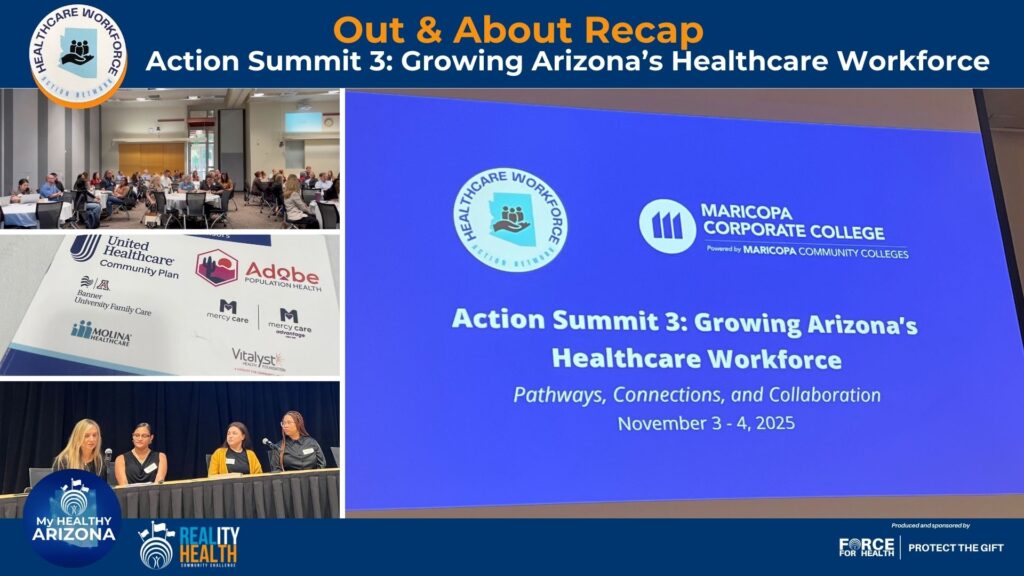
Out & About: Growing Arizona’s Healthcare Workforce – Pathways, Connections & Collaboration

By Lucy Howell, Co-Founder & CEO, The Force for Health® Network
November 3–4, 2025 | Rio Salado Conference Center, Maricopa Corporate College System
A Summit Rooted in Purpose and Partnership
As a proud member of the Arizona Healthcare Workforce Action Network (HWAN) and participant on the Summit Planning Committee, I was honored to represent The Force for Health® Network at this year’s Healthcare Workforce Action Summit III, themed “Growing Arizona’s Healthcare Workforce: Pathways, Connections, and Collaboration.”
Hosted at the Rio Salado Conference Center—part of the Maricopa Corporate College System—the two-day event brought together a powerful cross-section of healthcare professionals, educators, policymakers, and industry leaders united around a common goal: building a sustainable, inclusive, and resilient healthcare workforce for Arizona.
The event was made possible through the generous support of UnitedHealthcare Community Plan, Banner University Family Care, Mercy Care and Mercy Care Advantage, Vitalyst Health Foundation, Molina Healthcare, and Adelante Population Health—all organizations deeply committed to advancing health and well-being across our state.
Day One: Leadership, Resilience, and Respectful Beginnings
The summit opened with palpable energy and emotion as Dr. Sue Rowe, the visionary leader behind HWAN, received a standing ovation following heartfelt remarks from David Broski, Chair of the Coalition of Community Colleges of Arizona. Dr. Rowe’s courage and commitment were truly inspiring—just days earlier, she had experienced a serious health emergency while traveling, yet she stood before us, cane in hand, with grace, humor, and resolve. Her return to lead this event spoke volumes about the resilience and dedication that define Arizona’s healthcare community.
We were then welcomed by Mary Foote, representing Governor Katie Hobbs’ Office, who emphasized how central healthcare workforce development is to Arizona’s economy and community health. Dr. Steven Gonzales, Chancellor of the Maricopa Community College System, shared his own personal story of receiving care while out of state—a humbling reminder that we are all, at one time or another, beneficiaries of the compassion and skill of healthcare workers.
One of the most memorable moments of the morning followed: a Native American Four-Directional Blessing Ceremony, led by Dr. John Molina, Director of the Arizona Advisory Council on Indian Health Care. With a traditional feather in hand, Dr. Molina offered a blessing honoring the Four Directions, acknowledging the interconnectedness of all people, lands, and elements that sustain life in Arizona.
This opening—introduced by the summit’s planning and leadership board for the first time—was received with deep respect and appreciation. It provided a powerful and grounding way to begin the day, symbolically uniting everyone in the room across boundaries of culture, geography, and role. It reflected the very heart of our mission: honoring connection and shared purpose as we work to strengthen the health of all Arizonans.
Panels that Informed and Inspired
The first panel, “Arizona’s Healthcare Workforce: Urban and Rural Perspectives from Practice and Education,” moderated by Dr. Rowe, featured an exceptional lineup: Todd LaPorte (HonorHealth), Jackie Lundblad (Wickenburg Community Hospital), James Stringham (Drive Health), Dr. Gonzales (Maricopa Community Colleges), Todd Haynie (Eastern Arizona College), and Andy Anchia (Pima Medical Institute).
A standout takeaway came from Jackie Lundblad, who shared how her hospital is partnering with the Wickenburg School District to create a Health Academy directly on a school campus—a true “grow-your-own” model designed to recruit, train, and retain healthcare professionals within rural Arizona. Her approach underscored the value of local innovation and long-term investment in community talent pipelines.
The next session, “Arizona’s Regional Healthcare Workforce Initiatives,” moderated by Peter Boyle from the Center for the Future of Arizona, highlighted regional collaborations and innovative projects connecting students to hands-on learning. Leaders from across the state shared successes and challenges, emphasizing one consistent theme: the urgent need for more clinical and experiential opportunities for healthcare students.
Data, Integrative Health, and Insightful Collaboration
Later that morning, Doug Walls, Labor Market Information Director for the Arizona Office of Economic Opportunity, presented an eye-opening analysis of healthcare workforce trends, revealing both the magnitude of current shortages and the areas where partnerships are making measurable impact.
Lunch, sponsored by UnitedHealthcare Community Plan, featured keynote speaker Dr. Stephen Dahmer, Director of the Andrew Weil Center for Integrative Medicine at the University of Arizona. His presentation, “The Landscape of Integrative Healthcare,” explored the seven domains of wellness—trust and resilience, movement, sleep, nutrition, relationships, spirituality, and connection with nature. His message was beautifully aligned with our Force for Health® 360° model, reinforcing that holistic, preventive, and integrative approaches are essential to creating healthier communities and stronger healthcare systems.
From Data to Action: Statewide Solutions and Success Stories
The afternoon panel, moderated by Vicki Bush of the Arizona Hospital & Healthcare Association, showcased state and regional programs that are truly moving the needle on workforce development.
Key highlights included:
- Amber Smith (Pipeline Connects) shared that while healthcare ranks among the top career interests for Arizona students, many still lack confidence or access to clear career pathways—calling for stronger mentorship and guidance efforts.
- Kathy Scott highlighted the Student Nurse Clinical Rotation and Preceptor Training Pilot Program, funded through state grants. This initiative has already trained more than 18,000 nursing students and 7,800 preceptors, with an extraordinary 97% of preceptors continuing in their mentorship roles.
- Dr. Mindy McKenzie (ASU) discussed the Community Health Worker Program, which focuses on training, sustainability, and equitable compensation to ensure CHWs remain an integral and supported part of Arizona’s healthcare delivery system.
These discussions reflected a shared recognition that progress must be both data-driven and human-centered, built on collaboration rather than competition.
Day Two: From Change to Evolution
Day Two began with a warm welcome and breakfast sponsored by Mercy Care, followed by a powerful keynote from Barbara Lang, Health Director for Cochise County. Her talk, “Changing in Collaboration,” urged us to think not in terms of change but evolution—the steady, collective progress that happens when people and systems grow together. Her perspective was both grounding and inspiring, reminding us that sustainable transformation begins with empowered people, not just policy shifts.
The morning’s breakout sessions tackled critical themes:
- Funding and Sustainability 101, led by Kate Lemke and Jacqueline Arenberg, provided practical insights for nonprofit healthcare programs seeking long-term support.
- Cultivating Engagement and Retention, with Amy Mahon and Sunshine Dean, addressed workforce burnout and the importance of creating organizational cultures rooted in compassion.
- Advancing Workforce Through Apprenticeships and Preceptorships, moderated by Jenny Sumner (HonorHealth), featured Joanne Bueno (Arizona Department of Economic Security), Moises Pimental (Center for the Future of Arizona), and Myra Bryson (Banner Health).
A particularly memorable moment came when Joanne Bueno passionately declared:
“Silos are for corn—not workforce development!”
Her words drew laughter and applause, perfectly capturing the theme of the entire summit—breaking down barriers to build up our collective strength.
Closing Reflections
Leaving the summit, I felt both humbled and inspired. Every conversation, panel, and presentation reinforced that Arizona’s path forward depends on collaboration, innovation, and respect for the diverse communities that make up our healthcare landscape.
At The Force for Health® Network, our mission is to connect, educate, and empower individuals to Learn It, Live It, Share It™—and this event affirmed how vital that approach is when applied to workforce development. By combining health literacy, training, and equitable opportunities, we can help build the next generation of caregivers, leaders, and changemakers.
The summit ended as it began—with connection, purpose, and gratitude. It was a true celebration of what’s possible when we come together, honor our shared humanity, and work collectively toward a healthier Arizona.
Check out this emagazine below with interviews from key participants, summarizing key takeways through graphics and songs!
For direct link to a related blog on these interviews from the Summit, go to Out & About Recap: Voices from Arizona’s Healthcare Workforce Summit