
360 Human Explorer: Open Heart Surgery and CABG

If there are multiple blockages or ones that can’t be treated with a balloon or stent, this is a life saving or prolonging surgery.
What is Open Heart Surgery?
Have you heard about open heart surgery?
Does that mean they slice the heart open and do surgery on the inside?
No. It means they make an incision, open the chest, pull the lungs aside, enter the area called the mediastinum, and they find the heart.
So they open the body. They do not open the heart for this one.
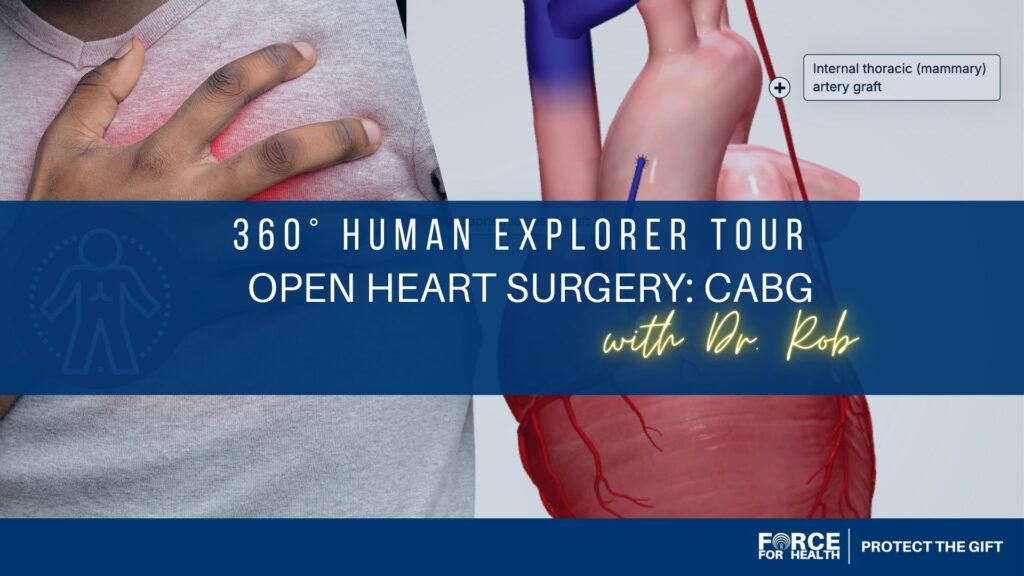
Then they do something called a bypass, or a CABG, coronary artery bypass surgery.
Let’s take a closer look at that type of open heart surgery.
As I look inside the Force for Health program and its apps, I can search this out with our 360 anatomy. Notice the body has a heart in it with veins that take the blood to the heart. The heart pumps it and then pumps it to the body to give it nutrients.
So as life goes on with this, let’s take a closer look.
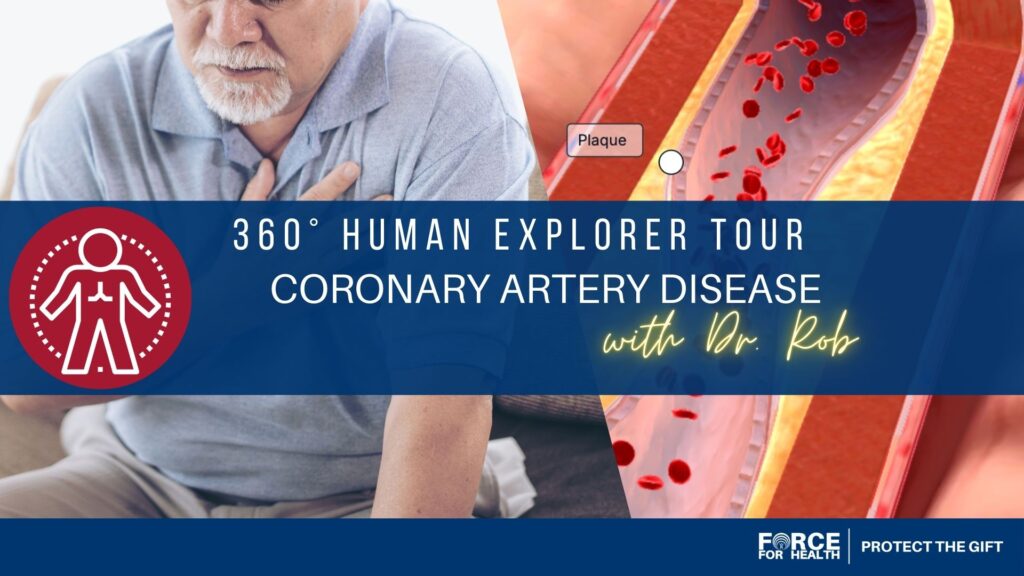
The coronary arteries feed the heart much like a sprinkler hose feeds the sprinkler in your garden. If that hose is blocked, if a car is on the driveway over the hose, everything downstream does not work and the grass dries out. That is a heart attack.
So when that happens, where there is plaque in the artery, there are a variety of different things that can happen. But the idea is to bypass the blockage, bypass the blockage from one side to the other so that downstream gets the blood.
So how do they do that?
One way is with a blood vessel called the internal mammary arteries. These automatically exist. They go to the tissue in the pectoralis or breast area of a man or woman, and those vessels are a good source of blood if they do not have blockages or plaque.
Other places you can harvest a vein. There is a multitude of veins in the leg. Many of them are white on this diagram to show the saphenous vein. When this vein is harvested, cut off, and tied off to let the blood go back to the heart through a different vein, that vein can come and be hooked up and attached to the aorta.
This massive vessel with high blood pressure can have the vein sewn on. It is sewed on and bypassed. It goes past or downstream from the blockage and the blood feeds the area, preventing a heart attack for a long time.
Used when simpler and less invasive treatments don’t work:
This can be done if there is one or two places where it is blocked. If it is blocked in tiny vessels, it cannot be fixed. With this type of approach, it is also difficult with a stent, and you are more treating symptoms with vasodilators and pain medicines. For someone who might have heard of nitroglycerin, that is one of those things.
Coronary artery bypass has existed for 40 or 50 years, and it is still a good modality to use. You need a good surgeon, you need a good team, and you should have it done in a place that is doing it often.
Lancaster General Hospital in Pennsylvania, where I worked, was the third busiest open heart surgery program in the state. They had a great program even though it was in a small community, but the department had many good the people.
Numbers Matter – Get Surgery where they do it routinely:
Mayo Clinic, Cleveland Clinic, Stanford, and Cornell have wonderful programs. Many regional hospitals do too. If you have heart disease and you are having trouble, and there is a choice between going to hospital A or B with an ambulance and they are equal distance, have them go to the place that has stenting or heart surgery so that you do not have to go to one place and then be transferred by ambulance or helicopter to the center.
I hope this helps you understand coronary artery surgery and open heart surgery.
In another video we will look at heart valve surgery and what that entails.
Dr. Rob Gilio here at the Force for Health saying let the beat go on. Be a force for your own health. Protect the gift of that heartbeat.