4 Lessons to Consider for Addressing Childhood Obesity

While childhood obesity remains a problem in the US, much progress has been made to address the epidemic over the past 20 years.
The Robert Wood Johnson Foundation (RWJF) recently published its 2025 State of Childhood Obesity Report to reflect on the national movement to address childhood obesity and its many accomplishments and lessons learned over time.
“Our work together has always been grounded in a simple belief: that every child should be able to grow up healthy, no matter who they are, where they live, or how much money their family has,” said Jamie Bussel, RWJF senior officer.
Let’s dive deeper into this report and how it can shape efforts to address childhood obesity.
1. Major Commitments Require Vision, Staying Power
The RWJF report describes the skyrocketing rates of childhood obesity and concerns over the long-term health impact during the early 2000s.
That is what led to RWJF’s initial $500 million pledge to reverse the epidemic.
“It was clear that all sectors of society—government, businesses, philanthropy, and nonprofits—would need to be engaged, even if the exact roadmap for each was still unfolding,” according to the RWJF report.
Today, the work is ongoing to help families and communities across the nation.
“Our work is ultimately focused not just on childhood obesity but on improving the health and wellbeing of children and families,” said Jessica Donze Black from the American Heart Association.
2. Evolution Is a Part of The Journey
Early research on reducing childhood obesity focused on diet and physical activity.
However, over time, experts found that many other factors are important:
- How safe communities are
- Whether parents can earn a living wage
- Whether kids have access to high-quality childcare and healthcare
- If a neighborhood provides healthy, affordable food
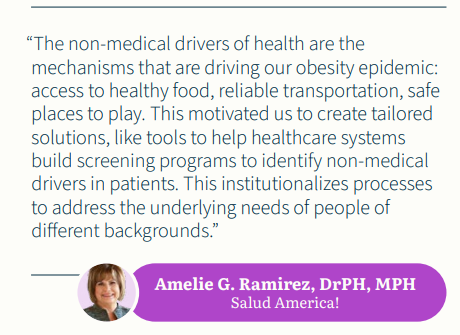
These “non-medical drivers of health” are the mechanisms that have driven up obesity rates, said Dr. Amelie G. Ramirez, leader of Salud America! and the Institute for Health Promotion Research at UT Health San Antonio.
“This motivated us to create tailored solutions, like tools to help healthcare systems build screening programs to identify non-medical drivers in patients. This institutionalizes processes to address the underlying needs of people of different backgrounds,” Ramirez said.
RWJF and their partners noticed that policies are important and changes can help others have access to healthier environments.
“It is essential to continue focusing on the upstream factors that contribute to childhood obesity and to recognize the complexity involved in addressing and unraveling them,” said Dr. Angela Odoms Young of Cornell University.
3. Community Leadership is Essential
It’s crucial for the communities being impacted by these health issues to have a voice.
“We needed to invest more time in building relationships and trust with communities,” according to the RWJF report.
Working closely with local leaders can broaden the impact, spark new ideas, and strengthen work approaches.
“Experiential expertise is important (i.e., people with varied expertise who work each day with children, adults, and families with the lived experience of obesity regardless of the setting—community, healthcare, schools),” said Dr. Ihuoma Eneli of the University of Colorado Children’s Hospital.
4. Self-Reflection Opens New Pathways
While reflecting on the ways to improve approaches to reducing childhood obesity, the RWJF highlighted the change in reliance on body mass index (BMI).
“Over time, it became clear that focusing on BMI in reports and stories contributed to stigma and caused real harm” according to the RWJF report.
With this in mind, it was clear that focusing on the policies and systems that shape health was important when addressing childhood obesity.
“As the field evolved, we all learned the importance of integrating a broader approach into the work.,” said Risa Wilkerson of Healthy Places by Design.
Looking to The Future
While there is still work to be done, many experts in the report listed reasons as to why they have hope for the future when it comes to reducing rates of childhood obesity, including:
- The next generation
- Shared commitment to improvement
- The growing demand for changes to our food system
- Community leadership
- Working across sector and policy
“A growing recognition that our food system is not serving public and planetary health, especially among young people who are clear-eyed about the world they want to live in,” said Dr. Neena Prasad of Bloomberg Philanthropies.
Improve Health for All People in Your Community
What is the status of health in your community?
Find out by downloading a Salud America! Health Report Card for your town!
Enter your county name and get auto-generated local data with interactive maps and comparative gauges on several health indicators. This can help you visualize and explore local issues in education, housing, transportation, food, health, and more.
See how your county stacks up compared to the rest of your state and nation.
Then email the Report Card to local leaders to raise awareness, include the data in a presentation or grant proposal, or share it on social media to drive healthy changes in your community!
The post 4 Lessons to Consider for Addressing Childhood Obesity appeared first on Salud America.










Responses