

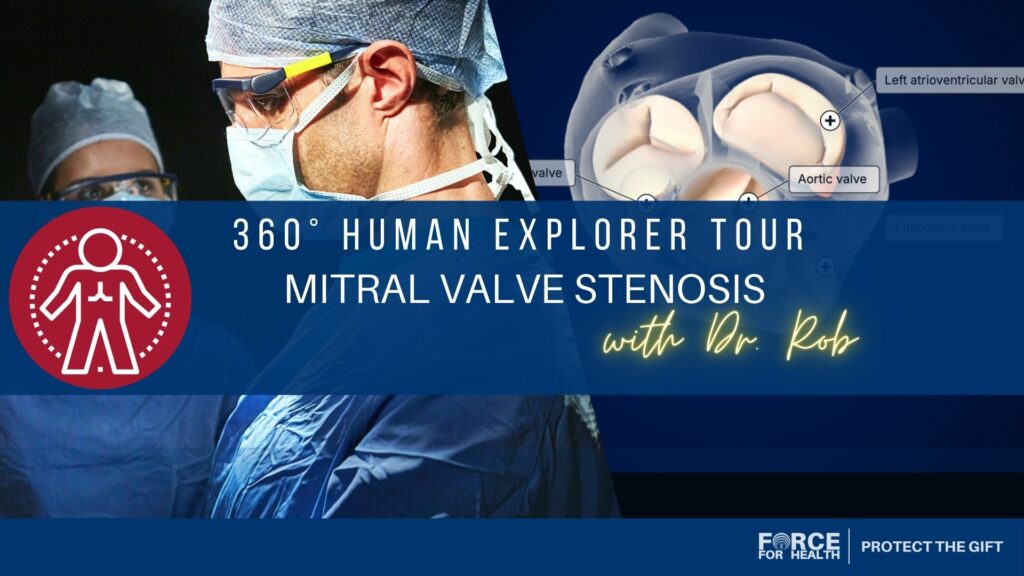
360 Human Explorer Tour: Mitral Stenosis

The mitral valve is key to keeping the blood flowing in the right direction to get to the rest of body. Let’s look inside the body and see it in action.
There are four valves in the heart.
Can you name them? I went to medical school, so I better be able to.
There’s the tricuspid with three cusps, the mitral, the aortic, and the pulmonary.
The aortic valve is in the aorta, a blood vessel. The pulmonic valve is right where the pulmonary blood vessel takes off.
The mitral valve is deep inside the heart and is a challenge because when it gets old or worn out, it can have problems with either being too narrow, which is stenosis, or regurgitating, where blood goes backwards.
Let’s take a look to better understand that structure.
Now looking at a heart here, and as I look closer inside the Force for Health Human 360, I want to show you something.
Look at this valve here. If I click on it, I’ll get the name of it. It’s the pulmonic valve.
Look how those three different flaps open all the way and close nicely, and they fit. This is a beautifully functioning valve. Look how smooth it is. That’s healthy, and the blood comes through it. When the blood flows backwards, the weight of the blood has this thing closed.
Now let’s take a look at a different valve.
Mitral Valve Tour
This happens to be, I believe, the mitral valve. Let me come back here.
What’s nice is that I can rotate this model and look at it from different sides. I’m going to click to make sure I’ve got the right valve. That’s the left atrium.
Here I’m going to click right on the valve. I’m still in the left atrium, but this is the mitral valve where the blood is trying to go through this valve into the ventricle.
Look how narrow it is. It has these plaques on it, which could be calcium, or it could be infection, and it makes the valve stiffer.
If I turn this valve around, I want you to look here a little bit. This is a really cool thing. These little ropes are called chordae tendineae.
I’m going to stop the heart. Don’t worry, no one’s going to die. It’s just for me to learn.
I want to take off the exterior of the ventricle because it’s in my way. All right, this is the mitral valve.
These are called papillary muscles. These little guys are cords, stiff little cords, like when you’re eating meat and you get something a bit gristly. These are like tiny tendons that hold this heart valve.
When the ventricle down here is contracting, the blood wants to flow the wrong way out the heart valve. These things are like ropes on a sailboat holding the sail.
When you have stenosis, it doesn’t open all the way. Sometimes, if a couple of these cords rip or if one of the papillary muscles breaks off and ruptures, it is like that sail just flopping in the wind.
When that happens, there is massive regurgitation of blood coming down into the left ventricle. When it pumps, instead of going out the aorta, a lot of it goes back up through that mitral valve.
With mitral valve blockage (stenosis) and leaking (regurgitation), the heart has to work ten or twenty times as hard, eventually outstripping its blood supply and causing a heart attack.
When it’s minor, it makes a murmur. Instead of the heart sounding through a stethoscope like “lub dub, lub dub,” it sounds more like “woosh woosh.” Those kinds of sounds are what the doctor hears through the stethoscope when listening to your heart.
Protect the Gift: Help your doctor hear your heart better.
By the way, my pet peeve: when you go to a doctor and you’re wearing a shirt, a T-shirt, and a sweater, and they’re listening to your heart, they can’t hear as well as if they do it on the skin. They’re not trying to get close to your chest or breast or expose you in any way. You can hear much better on the skin than through layers of clothing.
Heart valve disease causes murmurs. If you hear the murmurs early, you can get an echocardiogram, get a better look at those valves, and take care of them as opposed to waiting until the valves are really dangerous.