
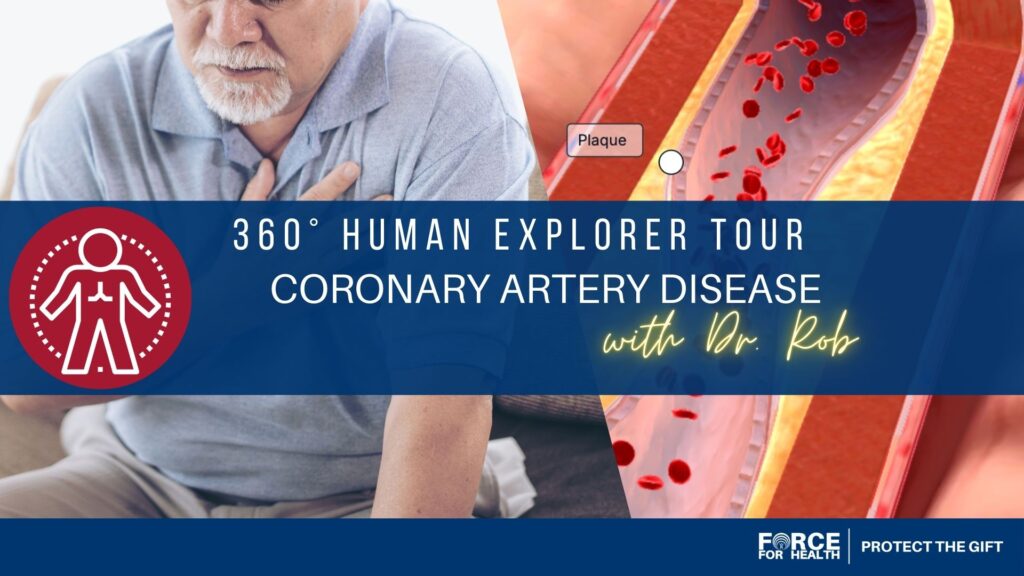
360 Human Explorer Tour: Coronary Artery Disease.

Tiny vessels called coronary arteries feed the heart. When they get blocked, a heart attack occurs. Let’s take a closer look inside. Come on our tour!
Your Coronary arteries
Your heart relies on blood vessels that are smaller than a pencil around.
Those are your coronary arteries.
And when you have coronary artery disease, you are at risk for a heart attack.
Let’s take a look at that in a little more detail.
Here’s a heart, and the heart has these blood vessels called coronary arteries that help the blood nourish the heart. These other large blood vessels get blood to the lungs, the pulmonary artery, and the rest of the body, the aorta.
Let’s Look Inside:
But let’s take a closer look at those arteries and try to simplify the picture.
Here are the arteries with the rest of the things erased. Let’s look inside the artery.
Inside the artery, you have blood flow. With this animation, the blood is going slowly, but normally it flows in a nice laminar flow, kind of like a river with no obstruction, making no noise or any other problem like that.
Over time, as one ages, they have found that coronary artery disease starts with fat between the two walls, the inner layer or endothelium, and the muscular layer. This fat or plaque starts developing.
Studies done on autopsies on war veterans who were twenty years old during the Vietnam War showed that this process starts in the twenties, or at least they already had it at that age.
Over time, it grows and gets worse, creating more and more obstruction.
Here you can see how it obstructs to the point where, if it narrows much further, the blood flow is going to be very restricted.
When that happens, the nourishment in the blood that is coming your way gets narrowed and doesn’t come through. Look at how it clumps. That clump and a rupture of this plaque can cause a sudden obstruction. No blood gets to that part of the heart, and in three to five minutes, it dies. It’s not a good thing.
So what can we do about it?
In the hospital setting, one approach is coronary artery surgery. But another more innovative approach, much less invasive, is called coronary artery stenting.
Remember, we said that the artery was narrowed. In this situation, coming from the wrist or the groin, a catheter or a steel wire—maybe titanium, I’m not sure what the wire is made out of—but a very flexible wire is fed through the blockage.
Then over that wire comes a soda-straw-like thing with an apparatus on it that I’ll show you in more detail. It has this little snake-type of thing. This is a little bit thicker than the lead in a pencil, but this part here comes through. It has a little marking so you can see it on the x-ray, and it has a balloon. That balloon gets inflated.
When that balloon inflates, it pushes that plaque aside.
Look at the opening now. The opening is about the same width as the rest of the artery.
But you can’t keep the balloon there. You can’t keep it inflated. While it’s inflated, there is zero blood flow, and you have to do this quickly or you’re going to kill the patient by stopping blood flow for a couple of minutes.
You get in there, you find it, you blow the balloon, and as you blow up the balloon, you expand this thing called a stent. It is like a little wire cage. That stent stays behind and holds that blood vessel open, and then the blood can start flowing.
Bottom line: do what you can to prevent coronary artery disease:
Exercise. Diet. Lower saturated fat, but use healthy fats like olive oil. Study the nutrition side in one of the other videos.
The point is, it happens to all of us to some extent as we get older, but to some of us, it happens in our fifties or sixties.
Take it seriously when that happens:
Tightness in the chest like an elephant sitting on your chest. Pain in your neck. Or in my case, no pain at all—just profound shortness of breath. In my mother-in-law’s case, it was, “I just don’t feel right. I’m feeling woozy.” It was a heart attack.
So if you’re not feeling right and something is going on with your chest, it could be coronary heart disease going to the point of a heart attack. Hopefully you have a hospital that can do a stent and do it quickly if you need it. It saved my life.
Now that you know about it, look around your community. Where would you go if you had heart disease? Hopefully they have a cardiologist, a cath lab, and even a heart surgeon.
In another video, we will look at coronary artery bypass graft.
Dr. Rob Gilio with the Force for Health saying let the beat go on for a long time.
Alright, take care.