

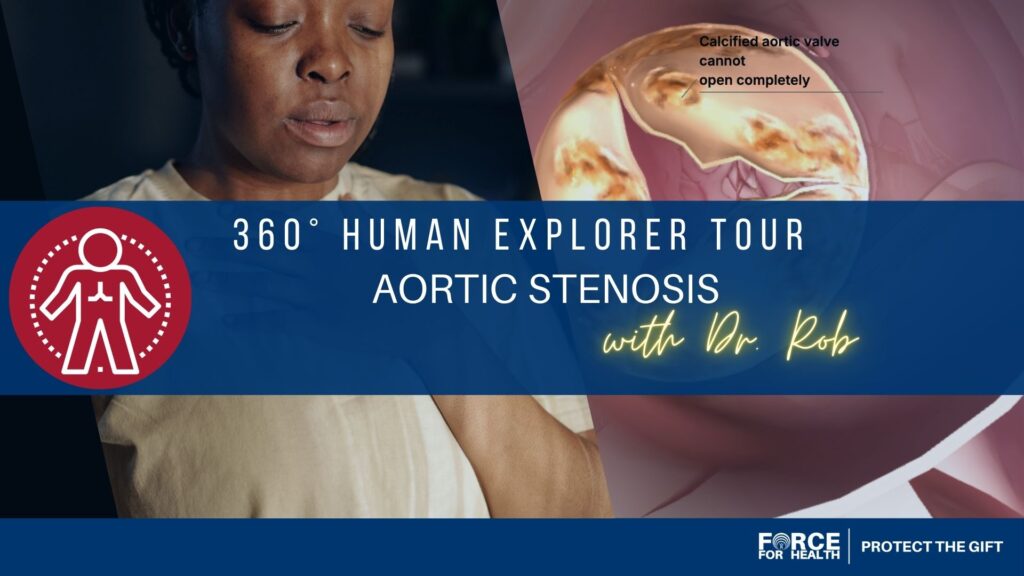
360 Human Explorer Tour: Aortic Stenosis

Pushing a liquid through a narrowed opening makes the heart work harder. Let’s take a closer look at this situation inside the body when it involves the aortic valve of the heart.
Dr. Rob’s Video Transcript:
“I am not that old, but I can tell you when you get old, everything gets stiff and does not work as well as it should. Some things wear out, and that happens to things like heart valves.
Let me show you aortic valve stenosis, and you will see how stiffness and aging become a problem.
Let’s look at the 360 Human Anatomy model from the Force for Health and take a bigger look at something.
Here you are seeing a heart valve from above. Let’s zoom out and you get a sense of where it is. It is right here. As I zoom out in this semi-invisible heart, the muscle of the heart is here, and then it shoots blood out these blood vessels, and they keep it from flowing back in.
The heart valves let the blood come through. When this opens, the blood is coming through, and when it tries to fall back, those leaflets fall together.
Let’s look a little more closely at these while I get a better position.
When I look at this area of the heart valve, you can see what I have there. I am going to hide this part of the blood vessel so you can see better.
Plaque Matters:
We have a situation where plaque, like in your blood vessels, makes this heart valve stiffer. It is kind of like arthritis of the heart valve, where you get extra deposits in there. This can also be infection from something called subacute bacterial endocarditis, meaning not obviously apparent, but germs can stick to this heart valve and cause an issue.
The heart valve should open all the way to the edge, but it does not, and that makes a narrower opening for the blood to go through. This is called stenosis. Now the heart has to work much harder to get the blood through.
That can happen to other valves as well, like the mitral valve, where it is a different type of structure. Let me get a better view. It is more like a sail on a sailboat, and those two sails come together when the blood tries to flow backwards. You can get stenosis and regurgitation from these valves.
Blockage affects blood pressure and increases risk of falls
The valves have to work right or things leak. When things leak, the pump has to work harder and harder to get the blood pressure up.
If you have aortic stenosis and you stand up quickly, your blood pressure will probably drop. That is why older people sometimes fall. They lose their balance when they stand up quickly. It can also be from dehydration, but aortic stenosis can make them orthostatic hypotensive. They stand up, lose blood pressure, and lose balance.
When they are walking or exerting themselves, like climbing stairs or walking outside in the winter, even walking to the car to get to the doctor’s office, that exercise can have the heart working too hard. If it works too hard, the blood from the coronary artery that feeds the heart may not keep up, and you can have a heart attack and die.
Another thing that can happen is you can get clots in that narrowed heart valve. Clots or even bacteria can flick off, go through the blood vessels, and cause an obstruction in various parts of the body. Depending on where that little piece lands, it could be a stroke, or a sudden loss of vision in one eye.
Aortic stenosis means the aortic valve, the valve in the aorta that comes out of the heart, is narrowed. There are treatments such as surgeries or catheters with a balloon or even a valve replacement.
There is something else called aortic regurgitation. We will look at that in another video.”